
A PERSIAN REFERENCE WORK · ENGLISH INTRODUCTION
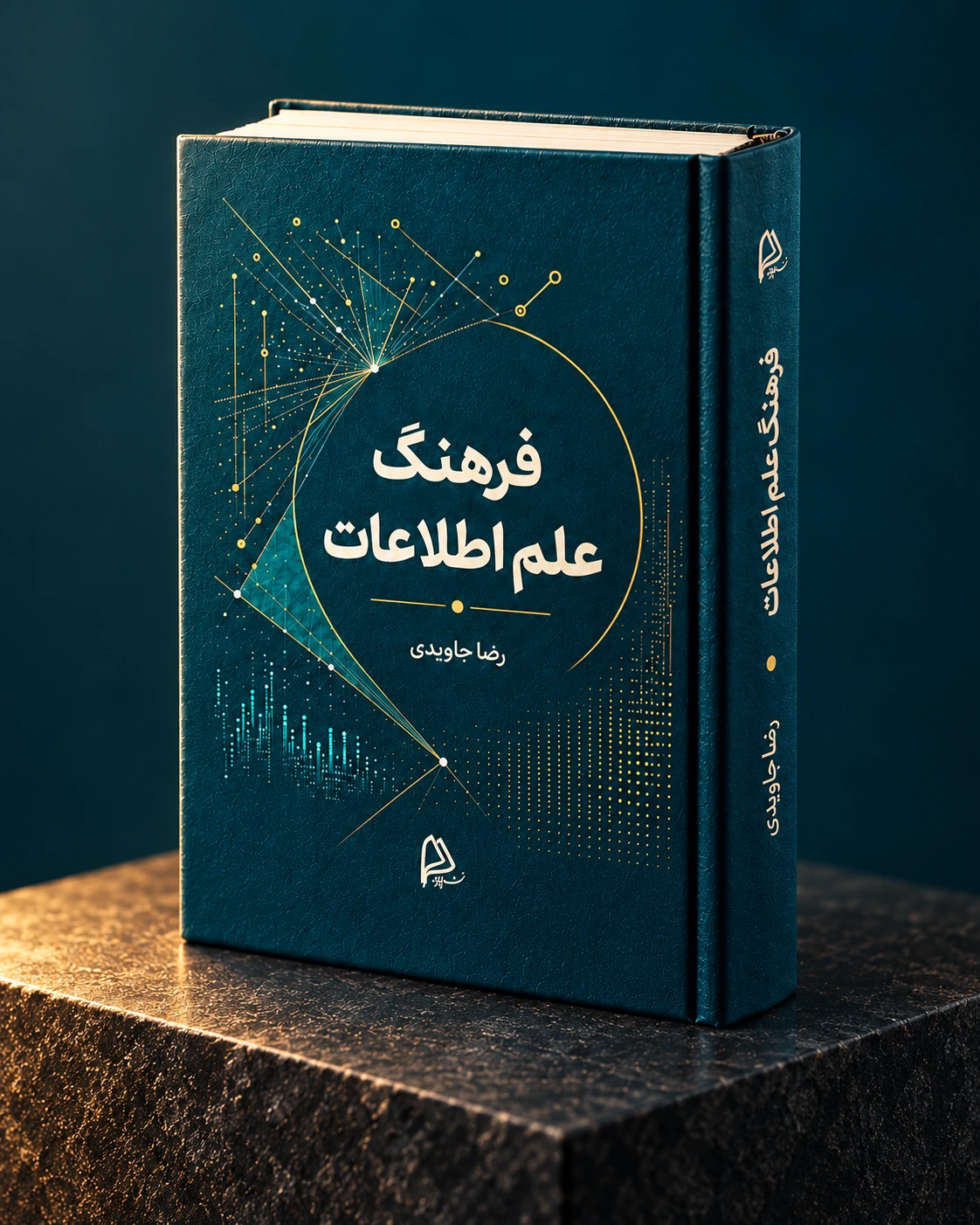
Dictionary of Information Science
A conceptual map of information science: from data and knowledge to information retrieval, artificial intelligence and ethics.
Written by Reza Javidi · Chapar Publishing
01 / THE IDEA
From a term to understanding
This Persian reference work supports finding a term, understanding its conceptual context and beginning further study. Entries pair a Persian term with its English equivalent and an explanation. Readers can approach an individual term or follow a subject through its related concepts.
A map for entering the literature of information science.
02 / SCOPE
Technical, conceptual, human
Technical concepts appear alongside user behaviour, philosophy and the social implications of information. The thematic organisation helps place individual terms within the wider field.
Information, data & knowledge
Fundamental concepts and distinctions that underpin further study.
Organisation & retrieval
Metadata, classification, semantic and vector search, and retrieval evaluation.
Technology & responsibility
Artificial intelligence, language, the semantic web, and the ethical and social dimensions of information.
03 / HOW TO USE IT
Two routes through the book
Each entry can become a starting point. The Persian name, English equivalent and conceptual explanation support quick reference and further searching in specialist sources.
Thematic reading
Choose a subject, locate its terms and follow the concepts around them.
Alphabetical lookup
Find a Persian term or its English equivalent and use the entry as a starting point.
04 / CONTENTS
20 chapters, a connected map
- Information and fundamental concepts
- Data, databases and data management
- Knowledge, cognition and epistemology
- Information theory, communication and coding
- Information science, scholarly communication and scientometrics
- Knowledge organisation, metadata and classification
- Information retrieval, search and evaluation
- Language, meaning, semiotics and natural language processing
- Artificial intelligence, machine learning and cognitive science
- The web, linked data and semantic technologies
- Logic, mathematics and computation theory
- Cybernetics, systems theory and complexity
- Data analysis, data mining and modelling
- Ethics, governance, security and information policy
- Information technology, infrastructure and applied systems
- Philosophy of information, society and information culture
- Key figures and thinkers
- Information behaviour, user research and information experience
- Research methods in information and knowledge science
- Complementary and interdisciplinary concepts
The English headings translate the Persian chapter titles. The book itself is in Persian.
05 / READERS
For beginning and continuing your study
The dictionary is a companion for reference and study. Its explanations provide a route towards deeper engagement with specialist literature.
Students
For building conceptual foundations and reviewing course terminology.
Researchers
For finding terms, choosing keywords and developing a theoretical framework.
Interested readers
For exploring the field and finding a route into further study.
06 / A READING ROUTE
From search to responsibility
One suggested reading route connects semantic search with language models, knowledge graphs and algorithmic transparency: technical concepts alongside questions of responsibility.
Information retrieval
Artificial intelligence
Web and semantic technologies
Information ethics
07 / EDITION & PUBLISHER
The Persian edition
- Title
- فرهنگ علم اطلاعات
- Author
- Reza Javidi
- Book language
- Persian
- Publisher
- Chapar Publishing
- Printing
- First printing, 1405 Solar Hijri
- Pages
- 560
- Structure
- 20 thematic chapters
- ISBN
- 978-600-276-325-9
08 / THE AUTHOR
Reza Javidi
Reza Javidi is an information science researcher, university lecturer, theatre photographer and director. This book represents his work as an author in information science.
RELATED BOOK